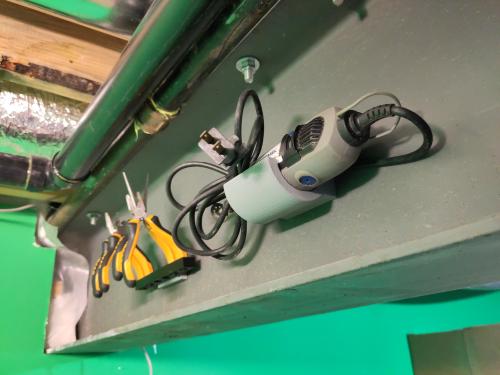

Quick to print, quick to deploy, and quick to remove, they’ll bind your cables and cords so tight that you’ll want to use them everywhere.
As I mentioned in a previous post, I need a system for storing little parts efficiently, and to me that means three things:
-
all parts are organized into collections of similar items
-
all parts are stored securely, with minimal risk of spillage or cross-cubby contamination
-
Each collection is easy to find, easy to put away, and requires zero gameplay (think Jenga or Towers Of Hanoi) to access
Many existing storage solutions tackle numbers 1 and 2, but number 3 seems surprisingly elusive, so I set out to solve it myself. And my motivating requirement? The first box you touch should always be the box you need.
◇◆◇◆◇◆◇◆◇◆◇◆◇◆◇◆◇◆◇
Imagine a library where the books were piled in stacks on the floor. Can you imagine a more useless way to organize a library? It wouldn’t matter how efficient the information was inside each book; the efficiency of your overall project would always be limited by the constant friction of having to move dozens of irrelevant books just to reach the one you needed. Every single time.
Worse, “piled stack” systems are self-perpetuating, because the only reasonable way to put an item away once you’re done with it is to put it on top of one of the piles, further burying all the items already in the stack. Every time you use one item, you make a dozen others harder to access the next time you need them. It’s insanity.
So instead, why not learn the lesson libraries teach us, and use the system they invented for storing random access things efficiently? On end, with spines facing out, and labelled with their contents. The only box you ever need to touch is the box you need. The FirstBox.
The Standard
After looking at the random stack of parts cases I’m replacing, I defined the FirstBox standard case size at 25 mm deep and 150 mm wide by 200 mm tall on the face, which gives plenty of room inside for lots of reasonably sized cubbies. When they’re filed on the shelf like books, they’ll all be 200 mm tall and 25 mm wide.
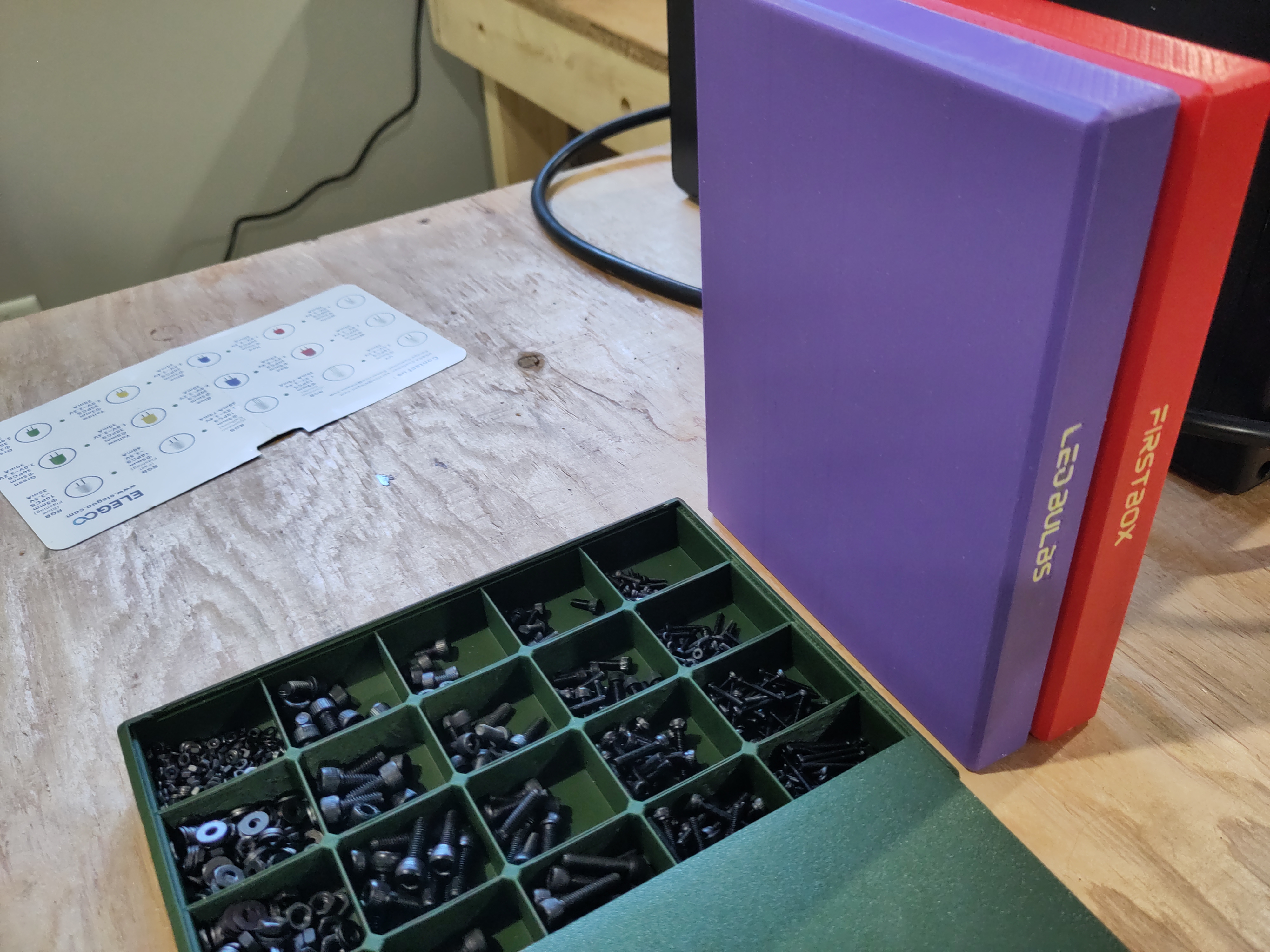
The lid fits snuggly, making solid contact with the tops of all the cubby dividers, so the contents won’t get scrambled inside the cases when they inevitably get tossed around.
If I need a smaller case, I could go with half cases at 150x100, and those could then be stacked in pairs, one atop the other, but that reintroduces the Jenga problem, so I personally treat the standard sized box as the minimum. If a case starts off only half full, that just means it has room for more bits later.
For chunkier parts, I sometimes need deeper cases, but I always make those cases an integer multiple of the standard 25 mm depth. This makes it easier to manage when I have an assortment of boxes on the workbench in an active project. They can be stacked evenly side by side and still be tidy. (Waitaminute! Stacks? Sigh. I know, but I have to be practical. Sometimes stacks just happen.)
(I know I keep going on about tidiness, and I don’t want to slide into anal retentive carpenter territory, but in my experience, a tidy organizing system makes everything much faster - both to scan when you’re looking for something, and to get things put away quickly.)
I haven’t decided if I’ll stick with these, because they do take a while to print, but I love how well they hold stuff.