2025-03-27
(Mod: 2025-05-27)
| 4 minutes
One of the things that inspired me to start FrankenTongues was the lack of tools I could find to use while exercising. Most systems require both your hands and your visual attention - holding a book or tapping a screen - so they’re out. Pimsleur kinda worked, but I want something at a higher language level, and I want to be able to create my own lesson content. So after taking a week off to just enjoy Frankie’s new ebook reading feature, I’m now ready to add another one. And this one’s going to be entirely hands-free.
◇◆◇◆◇◆◇◆◇◆◇◆◇◆◇◆◇◆◇
For my workout time, I want to be able to start the lesson and then shove my phone into a pocket and go. No text prompts to read. Nothing I’ll have to hold. No buttons to tap. I want the entire experience to be mediated through my headset. It’s possible that I could do something fancy with voice input controls, and I could probably hijack the media keys on my headset for a few more control inputs, but I want to keep this first mode simple, low tech, and accessible to everyone, so I’m assuming you’ve got nothing more than a pair of headphones.
Which means it’s going to be a passive system.
One thing I found surprisingly powerful about Pimsleur when I was starting, was the benefit of its simple “repeat after me” exercise structure. If the sample audio is clearly enunciated and presented at a speed appropriate to your learning level, and assuming you’re given adequate time to respond, you can go a long way by listening to a sentence spoken by a native, repeating it, and then listening carefully to the sound of your version and comparing it to the one you just heard.
Doing that much would provide us with a pronunciation practice system, but it wouldn’t help with the more demanding part of speaking: figuring out what to actually say. AI is rapidly approaching competence as a tool for unscripted conversation practice, but in the limited, offline context that I want this first tool to operate within, I think I can write simple scripts that describe a context and then prompt the user to compose their own sentences about it, giving them time to respond, and then offering some suggested responses. This will activate the mental language assembly processes and then provide feedback in the form of possible solutions. Like with the repetition exercises, it relies on the student to evaluate their own work, but since FrankenTongues is aimed at more advanced students, I think that’s actually better than doing the evaluation for them.
Here’s an example of the kind of script I’m imagining:
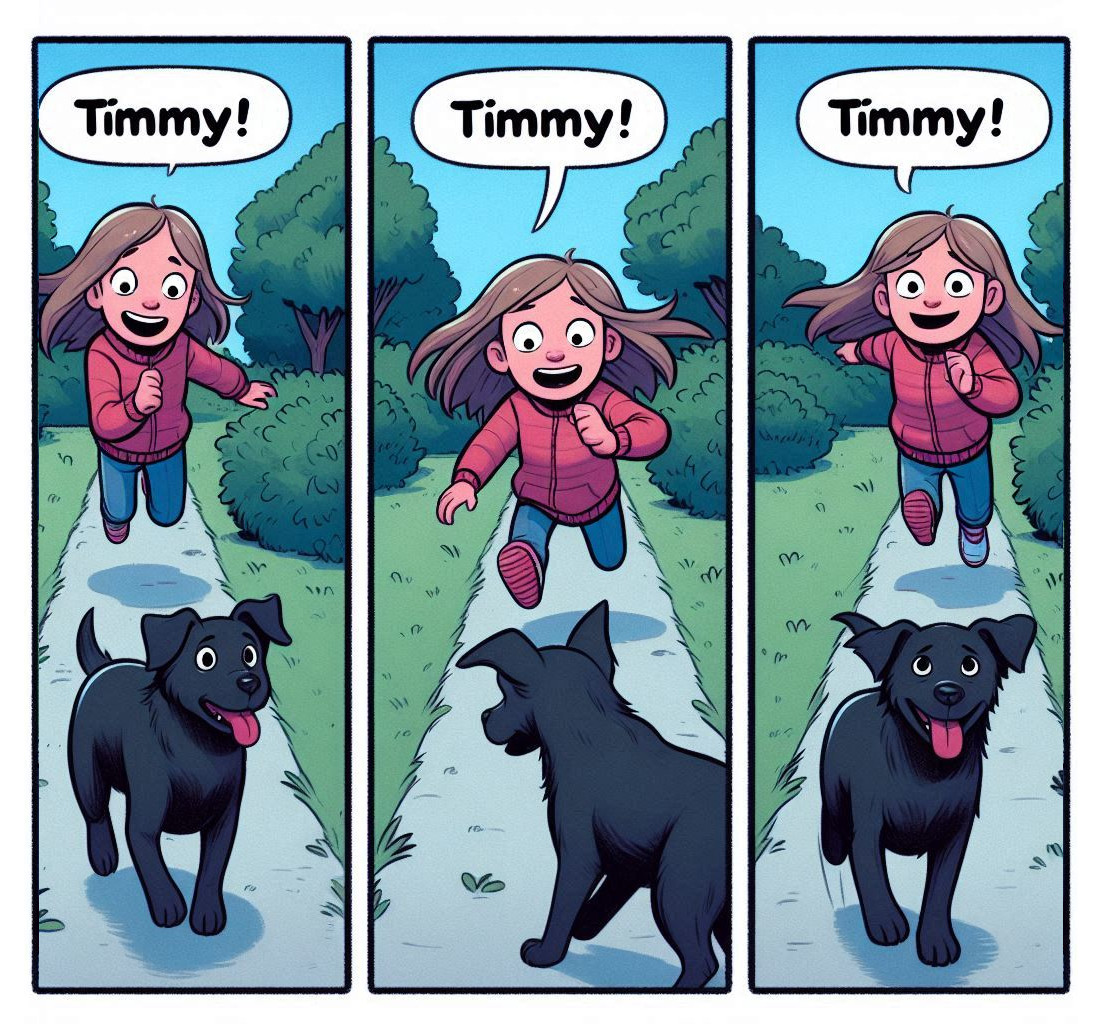
Frankie: You are walking to the park. A black dog runs past you and disappears into the bushes ahead. A minute later, a young girl runs past you, looking around frantically and calling “Timmy! Timmy!” What is going on?
User: She’s looking for her dog.
Frankie: Here are three possible responses, in increasing order of complexity. Repeat each one:
-
She is looking for the dog.
-
The girl is trying to find her missing dog.
-
The dog has run away from the girl and she is chasing him.
The benefit here, I hope, is that the setup prompt paints a picture in your head, but it doesn’t tell you what’s going on or what to say, so you have to fully engage your language centers, first to parse the scenario and reach a conclusion, and then to take that information and articulate a response of your own. Then it gives you some model answers, but again, you have to decide for yourself how well you did.
I think this is quite a bit more mentally activating than the Pimsleur way: You meet a woman and ask her if she wants to come to your house for coffee. Say, “Would you like to come to my house for coffee?”
I’m also thinking about writing 6 or 8 model answers for each scenario and letting Frankie choose 3 at random to offer you. That will provide a bit more replay value in each lesson, but nuances like that will emerge once I get into the thick of it.